
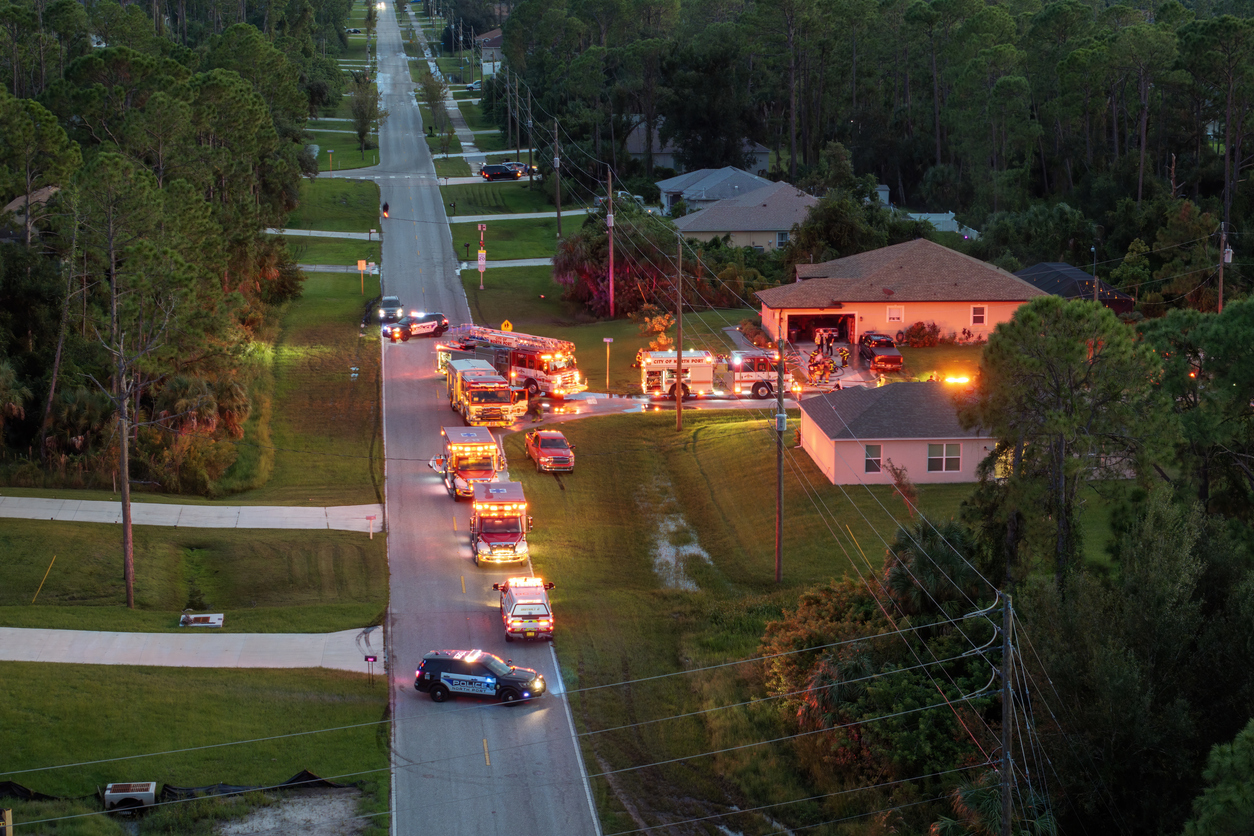
Summer response season compresses risk into a short window. Wildfires expand across jurisdictions, severe weather events strain regional resources, and large public gatherings require coordinated standby operations across multiple agencies. When departments work together, they move faster and cover more ground — but that operational advantage comes with layered liability exposure that standard policies don’t always address. Fire department insurance built for single-department operations can leave gaps when multiple agencies share a scene.
How does fire department insurance apply during multi-agency emergency responses? Coverage may extend — or fall short — depending on how mutual aid agreements are structured, which department’s equipment caused a loss, and where command authority resided at the time of an incident.
Why Do Multi-Agency Emergency Responses Create Unique Liability Risks?
Mutual aid agreements give departments access to personnel, apparatus, and resources they couldn’t deploy on their own. During major wildfire responses and regional disaster activations, that kind of cooperation is often the only way to manage the scope of an incident. But shared operations blur accountability. When two departments operate on the same scene under a unified command structure, questions about who directed a specific action — and whose policy governs a resulting claim — don’t always have clear answers.
The National Interagency Fire Center coordinates multi-agency wildfire response across the country. Those deployments routinely involve departments operating outside their home jurisdictions under shared incident command frameworks. Apparatus collisions during staging, property damage from coordinated suppression efforts, and injuries to personnel from visiting agencies can create claims that may affect more than one department’s coverage program.
What Insurance Issues Can Arise During Shared Fire Response Operations?
General liability coverage addresses third-party bodily injury and property damage claims. But when multiple agencies respond together, determining which department’s coverage applies requires careful examination of the policy language. Excess liability coverage becomes relevant when a claim’s value exceeds the limits of the underlying policy — a real possibility in large-scale incidents involving significant property damage or serious injury.
Borrowed equipment and shared apparatus usage create additional exposure. If a visiting department operates a host department’s ladder truck and damages it, coverage responsibilities depend on how the mutual aid agreement addresses equipment liability and whether the borrowing department carries coverage that extends to non-owned apparatus. Volunteer departments assisting neighboring municipalities face a similar problem, and many carry policies that do not account for cross-department scenarios.
The National Fire Protection Association publishes standards that inform how departments structure operations during joint responses. Agents who reference those frameworks when reviewing policy language give clients a benchmark for identifying where coverage may not keep pace with actual operations.
How Can Fire Departments Improve Risk Management Before Joint Responses Occur?
Waiting until an incident occurs to work through coverage questions puts departments in a difficult position. Agents can encourage fire department clients to review mutual aid agreements alongside their insurance advisors before peak response season, not after. Those agreements should address equipment liability, personnel supervision, and the transfer of operational authority when departments from different jurisdictions integrate into a unified command.
Documenting incident command procedures and training standards in advance reduces confusion during high-pressure operations. Pre-season coordination meetings with neighboring departments allow leadership to align expectations before a wildfire or major storm makes those conversations urgent.
A few specific exposures worth reviewing before summer include drone use during aerial reconnaissance, temporary equipment staging areas on private or municipal property, and mobile command centers deployed to unfamiliar jurisdictions.
Start Coverage Reviews Before the Season Peaks
Multi-agency responses increase operational reach, but they also stack liability exposures in ways that catch departments off guard. Agents add real value when they help clients understand how their policies work in shared-response scenarios before a joint incident triggers a claim.
To explore coverage options designed for the realities of coordinated fire and emergency response operations, get in touch with Provident FirePlus today.
About Provident FirePlus
Founded in 1902, our rich history includes the creation of custom firefighter insurance benefits in 1928. Today, Provident FirePlus continues to be a pioneer in developing insurance programs for firefighters, EMS providers, municipal entities, and law enforcement. In addition, we provide Special Risks insurance for various volunteer and nonprofit groups. Give us a call today at (412) 963-1200 to speak with one of our representatives.