

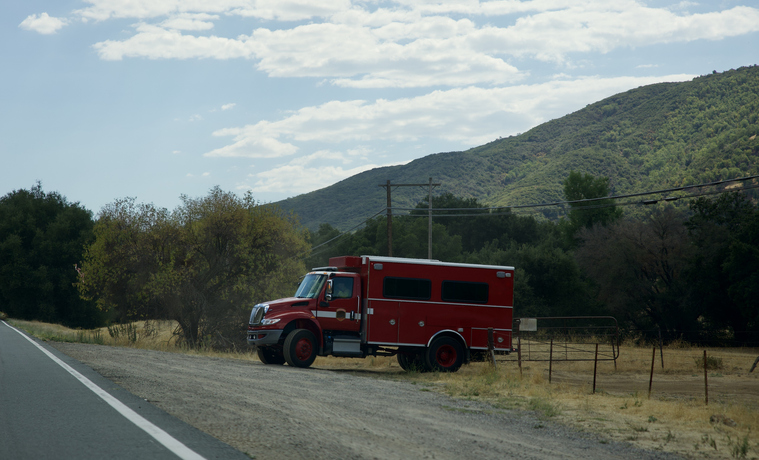
Brush fire seasons continue to stretch longer and behave less predictably, especially in rural regions where terrain and limited resources complicate response. According to the National Interagency Fire Center, 77,850 wildfires burned more than 5.1 million acres in 2025, reinforcing how frequently departments face fast-moving incidents. For insurance agents, this raises an important question: Why do rural fire departments need specialized insurance for brush fire risk? The answer starts with understanding how liability exposures differ and how tailored fire department insurance programs address those risks.
What Makes Brush Fire Risk Different for Rural Fire Departments?
Rural fire departments operate in environments where containment proves more difficult. Wide-open landscapes, limited hydrant access, and delayed response times allow fires to spread quickly beyond initial control lines. These conditions increase the likelihood of third-party property damage.
Many rural departments also rely on volunteer personnel and mutual aid agreements. While these partnerships expand response capabilities, they introduce operational variability. Different training standards, equipment types, and command structures can complicate decision-making during active incidents. For insurance agents, that variability directly affects how liability attaches when multiple entities respond.
Where Do Liability Exposures Arise During Brush Fire Response?
Brush fire incidents create several clear liability scenarios that agents must evaluate:
- Fire escapes containment and damages neighboring structures, farmland, or infrastructure.
- Equipment-related issues, such as sparks from apparatus or malfunctioning tools, contribute to fire spread.
- Injuries occur to civilians or volunteers operating within or near the fire zone.
General liability coverage plays a central role in addressing third-party bodily injury and property damage claims. However, agents should not assume coverage automatically applies across all responding entities. Mutual aid agreements often leave gaps in how responsibility is shared.
Key questions to consider include: Who assumes liability when multiple departments operate under a unified command? How does coverage respond if a volunteer from one district contributes to a loss in another jurisdiction? These are not theoretical concerns. They shape how claims develop and how coverage responds.
How Can Excess Liability Strengthen Protection for High-Severity Events?
Brush fires can escalate into large-loss events within hours, especially when they reach populated rural communities or wildland-urban interface areas. Primary general liability limits may not fully address the scale of resulting claims.
Excess liability coverage provides an additional layer of protection when losses exceed underlying policy limits. This becomes critical in scenarios involving multiple damaged structures, agricultural losses, or injury claims tied to evacuation or response operations.
Litigation trends also play a role. Even smaller municipalities face increasing claim severity due to rising reconstruction costs and legal expenses. A single brush fire that spreads beyond containment could quickly exhaust primary limits, leaving departments exposed without excess coverage in place.
What Should Agents Look For When Placing Fire Department Insurance?
Agents working with rural fire departments should approach placement with a structured evaluation:
- Review mutual aid agreements to confirm how liability extends across jurisdictions.
- Assess training and equipment protocols to identify strengths and gaps in risk mitigation.
- Evaluate policy limits based on community exposure, including acreage, structures, and proximity to high-risk zones.
This checklist helps agents align coverage with real-world operational risk rather than relying on standard policy assumptions.
Building a Smarter Insurance Strategy for Brush Fire Risk
Brush fire exposure is not only an operational challenge. It is a liability issue that demands careful coverage design. Combining general liability with excess liability strengthens protection against both routine incidents and high-severity events.
Insurance agents who understand these dynamics can deliver more effective fire department insurance solutions and help clients navigate complex risk environments with greater confidence. To build a program that reflects today’s brush fire realities, get in touch with us.
FAQ: Brush Fire Risk and Insurance Considerations
Why do rural fire departments need specialized insurance for brush fire risk?
Rural departments face higher exposure to fire spread, mutual aid complexity, and limited resources. These factors increase liability risk and require tailored coverage solutions.
Does general liability cover all brush fire-related claims?
General liability addresses third-party injury and property damage, but coverage may vary depending on jurisdictional agreements and policy structure.
When should excess liability be added?
Agents should consider excess liability when potential losses could exceed primary limits, especially in areas with higher property values or dense development near wildland zones.
About Provident FirePlus
Founded in 1902, our rich history includes the creation of custom firefighter insurance benefits in 1928. Today, Provident FirePlus continues to be a pioneer in developing insurance programs for firefighters, EMS providers, municipal entities, and law enforcement. In addition, we provide Special Risks insurance for various volunteer and nonprofit groups. Give us a call today at (412) 963-1200 to speak with one of our representatives.